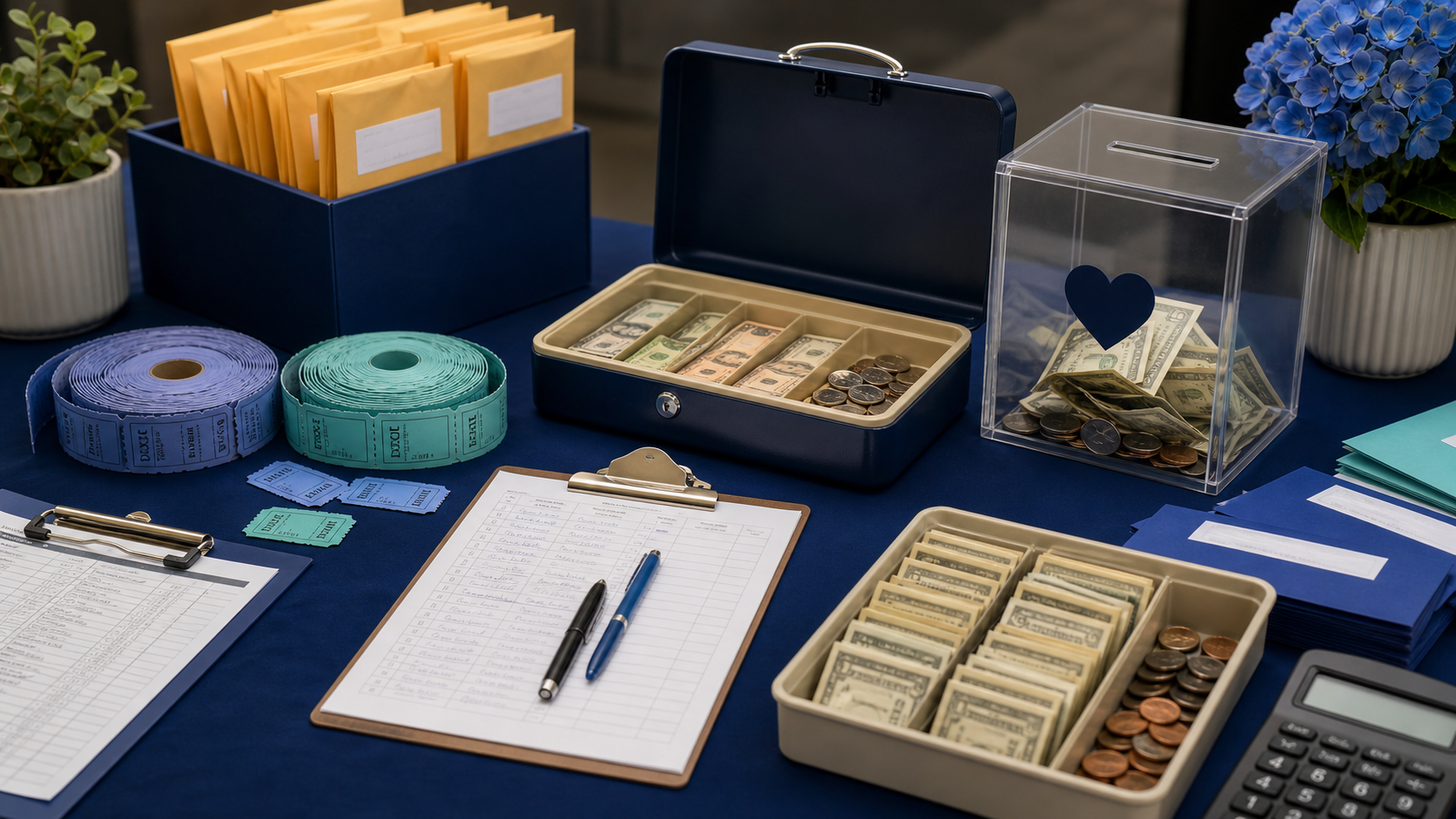
Event cash is handled fast, by volunteers, in poor light, under time pressure. The controls that work are the simple ones: numbered floats, logged points, paired counts, and a printed breakdown from the Change Counter calculator before anyone goes home.
Cash alone cannot be reconciled. Numbered tickets, wristbands or a stock count give you an independent expectation, and without one the takings figure is unverifiable by definition.
1. Issue Numbered Floats
Every collection point starts with a counted float in a numbered bag, signed for by the person taking it. Without that, the closing count has no starting point and the entire evening becomes one unverifiable figure. Preparation the day before makes this straightforward.
Sizing Event Floats
Event floats need more small denominations than a shop till, because most transactions are round numbers paid with large notes. Running out of change at a door mid rush is what causes volunteers to start pooling cash between points, which destroys reconciliation.
- Count and bag floats the day before, not on the night.
- Number each bag and record who signed for it.
- Weight the mix towards small denominations.
- Prepare spare change bags for the busiest points.
2. Log Every Collection Point
Keep a sheet listing each point, its float number, the volunteers assigned and the times it opened and closed. Points get added on the night when a queue builds, and an unrecorded point is cash with no owner and no expected figure.
Handling Changes On The Night
When a point is added or moved, update the sheet immediately rather than intending to. The person coordinating should hold the sheet physically, because a shared document nobody can reach in a marquee is the same as no document at all.
- Record point, float number, volunteers and times.
- Update the sheet the moment anything changes.
- Keep the master sheet with one named coordinator.
- Close unused points formally rather than abandoning them.
3. Brief Volunteers Before Doors
Five minutes before opening covers more risk than any amount of written policy. Explain the price list, what to do with a large note, where drops go, that cash never moves between points, and who to call. Most event cash problems are briefing failures rather than dishonesty.
What To Emphasise
Two rules matter most: cash stays at its own point, and nothing is paid out of takings. Volunteers buying supplies from the door float with the best intentions is a routine cause of unexplained shortages at events.
- Cover pricing, large notes, drops and escalation.
- State clearly that cash never moves between points.
- Prohibit any spending from takings.
- Name the person to call and make sure they are reachable.
4. Run Interim Safe Drops
Remove accumulated cash from busy points during the event rather than letting it build. Each drop goes into a numbered sealed bag, logged with the point, amount, time and both names. Drops reduce exposure and break a long evening into countable segments.
Timing The Drops
Schedule them around natural lulls rather than at fixed clock times, and always send two people. A single volunteer carrying an unsealed bag of takings across a dark site is a risk that costs nothing to remove.
- Seal and number every drop bag at the point of collection.
- Log point, amount, time and two names.
- Send two people, never one.
- Drop during lulls rather than at fixed times.

5. Count In Pairs After Close
Count each point separately once it closes, with two people and the point sheet in front of you. Counting everything together at the end produces one number that cannot be traced back to any point, which makes a discrepancy impossible to investigate.
Keeping Points Separate
Resist the urge to pool bags to speed things up. The extra ten minutes of counting separately is what allows you to say which point was short, and that is the only thing that will help you plan next year. Counting method in counting a cash drawer.
- Count each point separately with its own float deducted.
- Use two people for every count.
- Label each saved count with the point name.
- Print or export before merging any figures.
6. Separate Tickets From Donations
Ticket income and donations are different in accounting, and often in tax treatment. Collect them in separate containers at the point of receipt, because separating them afterwards is guesswork dressed up as a figure.
Practical Separation
Two visibly different containers work better than instructions. Where a donation is added to a ticket purchase, have the volunteer split it at the moment of the transaction rather than at the end of the night when nobody remembers.
- Use visibly different containers for each income type.
- Split combined payments at the point of sale.
- Count and record each type separately.
- Never estimate a split after the event.
7. Reconcile Against Sold Stock
Compare takings against something countable: numbered tickets issued, wristbands used, programmes sold. The comparison is what turns a total into a verified figure, and it identifies a short point rather than leaving you with a vague sense that the night felt busier.
Explaining The Gap
Concessions, comps and door discounts all create legitimate gaps, so record them as they happen. A reconciliation that ignores concessions will always show a shortage, and staff will learn to ignore it exactly as they would in a shop.
- Issue numbered tickets or wristbands wherever possible.
- Record concessions and comps at the time.
- Reconcile each point against its own stock movement.
- Investigate a gap that is not explained by recorded discounts.
8. Report To The Committee
Produce one document showing each point, its float, its takings, its variance and its reconciliation against stock. A committee, a treasurer or a funder needs the breakdown rather than a single figure, and assembling it on the night takes minutes.
Keeping It Comparable
Use the same report format every event so figures can be compared year on year. Consistent reporting is what turns event cash from an annual scramble into something that improves. See building a count sheet for a template approach.
- Report per point, not just an event total.
- Include floats, takings, variance and stock reconciliation.
- Complete counted by and verified by for each count.
- Keep the format identical between events.
Worked Example
A community festival runs three ticket points and two donation buckets. Each point is floated, logged and counted separately, and the reconciliation compares takings against numbered tickets.
| Point | Float And Takings | Reconciliation |
|---|---|---|
| Main gate | Float 150, counted 2340 | 437 tickets issued, agrees |
| Side gate | Float 100, counted 880 | 168 tickets, two comps recorded |
| Late desk | Float 100, counted 415 | 83 tickets, agrees |
| Bucket A | No float, counted 268 | Donations, no stock comparison |
| Bucket B | No float, counted 191 | Donations, no stock comparison |
| Interim drops | 3 bags, 1800 total | Bag numbers logged and matched |
Each count is saved under its point name and printed with both volunteer names on it. Because the Change Counter calculator keeps the denomination breakdown, the treasurer can see the note mix as well as the totals.
Final Checklist
- Count and bag numbered floats before the event day.
- Maintain a live sheet of points, floats and volunteers.
- Brief every volunteer before doors open.
- Run sealed, logged interim drops in pairs.
- Count each point separately after it closes.
- Keep ticket income and donations apart throughout.
- Reconcile each point against tickets or stock issued.
- Produce one per point report in a consistent format.
Events reward preparation more than any other cash environment, because there is no chance to fix a process once the doors open. Almost all of this list happens before the event starts.
Frequently Asked Questions
How do we handle a volunteer who cannot account for a difference?
Treat it as a process question first. Shared buckets, unbriefed volunteers, no float record and spending from takings account for most event shortages. Fix the structure before you look at individuals, and make sure next year each point has one named owner and its own numbered float.
Is it worth counting each point separately?
Yes, and it is the single most valuable control at an event. A pooled total tells you the evening was short. Per point counts tell you which point, which volunteers, which time window and which process failed, and that is the only version you can act on.
What about card and mobile payments at an event?
Keep them entirely separate from the cash reconciliation. Reconcile card takings against the terminal settlement report and cash against the physical count, then combine only at the final income summary. Mixing them at the counting stage makes both figures unverifiable.
Put It Into Practice
Set up the point sheet and the numbered float bags for your next event before anything else. Those two items alone remove most of the reconciliation problems that events routinely produce.
Keep reading: Counting Money By Denomination The Reliable Way, Cashier Closing Procedure Checklist For Retail, Restaurant Cash Drawer Closing Guide For Managers, How To Count Cash On Your Phone Accurately. The full cash counting guide library collects all fifteen walkthroughs, and the Change Counter calculator is always one click away.