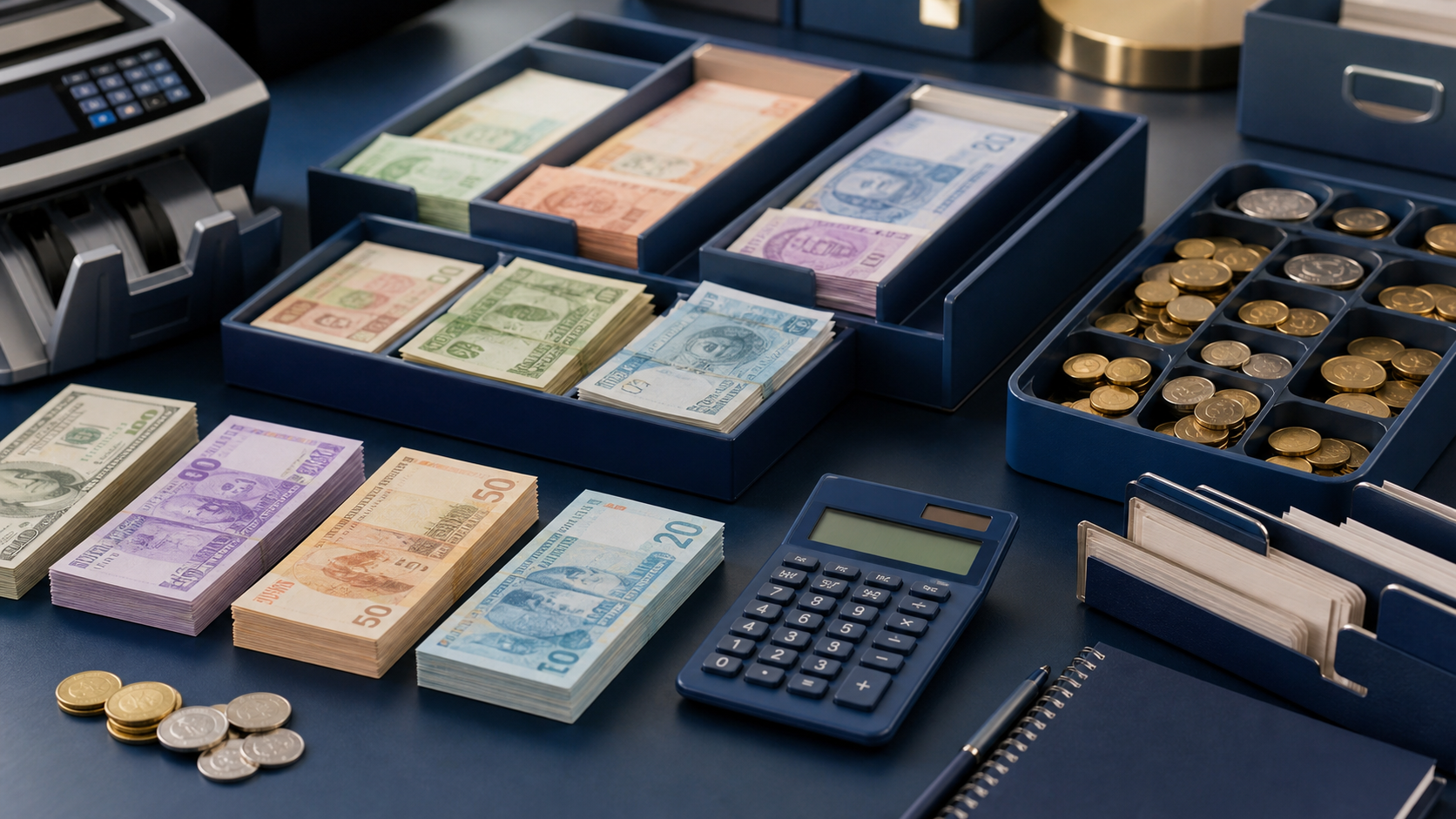
Tourist sites, airports, events and border businesses all handle several currencies at once. Count each one completely in its own denomination set using the Change Counter calculator, and convert only after every currency has its own verified total.
Converting as you go bakes an exchange rate into a physical count. Count each currency in its own units, record the rate separately, and keep the two figures independent.
1. Physically Separate The Currencies
Separation happens at the point of receipt, not at the count. Give each currency its own compartment, tray or envelope in the drawer, because sorting a mixed pile of similar sized foreign notes at the end of a shift is slow and error prone in a way that separating at the till is not.
Similar Looking Notes
Several currencies use similar colours and sizes at common denominations, and under artificial light at speed they are genuinely easy to confuse. Physical separation removes the identification problem entirely rather than relying on staff to catch it.
- Separate at the point of receipt, not at closing.
- Give each currency its own physical compartment.
- Label compartments with the currency code, not a flag alone.
- Keep a spare envelope for currencies you rarely see.
2. Count Each Currency Whole
Finish one currency completely, record it, then start the next. Interleaving them means holding two denomination structures in mind at once, which is exactly where a note gets entered against the wrong currency and produces two errors from one mistake.
Working Through A Session
Order the currencies by volume, starting with the one you hold most of while attention is sharpest. Export or save each currency before switching, since changing the selected currency clears the entries by design.
- Complete and record one currency before starting another.
- Start with the highest volume currency.
- Save or export before switching currency.
- Keep counted cash for each currency physically apart.
3. Never Mix Denomination Sets
Each currency has its own notes, coins, symbol and decimal behaviour. Some have no minor unit at all, some circulate a face value as both note and coin, and some use denominations that have no counterpart elsewhere. Counting one currency against another set produces a plausible and entirely wrong total.
Decimal Differences
Currencies without a minor unit will show whole numbers only, and forcing a decimal figure into them is a sign the wrong set is selected. Check the symbol and the decimal behaviour against the physical cash before entering anything.
- Select the correct currency before entering any quantity.
- Check the symbol against the notes in your hand.
- Watch for currencies with no minor unit.
- Keep note and coin rows separate for duplicate face values.
4. Label Every Bundle
Every bag, envelope and strap carries its currency code, denomination, quantity and value. Foreign cash sits in a safe far longer than domestic takings, and an unlabelled bundle of unfamiliar notes discovered weeks later has to be counted from scratch.
Codes Not Symbols
Use the three letter code rather than a symbol, since several currencies share the dollar and pound signs. A bag marked with a dollar sign alone is ambiguous across a number of currencies, and that ambiguity is what causes a wrong rate to be applied.
- Use three letter codes on every label.
- Include denomination, quantity, value and date.
- Label at the point of counting, not later.
- Avoid symbols that several currencies share.

5. Record Rates At Count Time
If you report a converted value, record the rate used and the moment it was taken. A converted figure without its rate cannot be checked or reproduced, and rates move enough that a conversion done a week later will not reconcile against the original.
Choosing A Rate Source
Use one documented source consistently, whether that is your bank, a central bank reference or your accounting system. Switching sources between counts introduces differences that look like counting errors and are not, which wastes considerable investigation time.
- Record the rate, the source and the timestamp.
- Use one documented source consistently.
- Keep the original currency figure alongside the conversion.
- Never reuse a rate from a previous count.
6. Convert After Counting Not During
The physical count and the conversion are separate activities with separate error modes. Counting produces a figure in the original currency that is verifiable against the cash. Conversion produces a reporting figure that depends on a rate. Keep them apart so each can be checked independently.
What Your Record Should Show
Show the original currency total, the rate, the source and the converted value on the same line. Anyone reviewing it can then verify the count against the cash and the conversion against the rate without the two being entangled.
- Verify the original currency total before converting.
- Show original, rate and converted value together.
- Do not enter converted amounts into a denomination count.
- Keep the per currency breakdown in the record.
7. Handle Rounding Explicitly
Conversion produces fractions that have to be rounded somewhere. Decide the rule in advance, apply it at the total rather than per denomination, and document it. Rounding each row separately accumulates a drift that appears as an unexplained difference in the reported figure.
Where Rounding Bites
The effect is largest with low value coins in high volume, which is exactly what accumulates in a tourist facing business. Rounding at the currency total keeps the drift to a single small amount rather than multiplying it across every row.
- Round at the currency total, never per row.
- Document the rounding rule in the procedure.
- Apply the same rule to every currency.
- Show the unrounded original alongside the reported figure.
8. Keep A Per Currency Audit Trail
Produce a separate record for each currency showing its denomination breakdown, its total in original units, the rate applied and the converted value. One combined figure is unverifiable, because it cannot be traced back to any physical count.
Filing For Later
File the per currency records together as one set per counting session, so a query about a single currency can be answered without reconstructing the whole session. The sheet design principles in building a daily cash count sheet apply directly.
- Produce one record per currency, not one combined sheet.
- Include breakdown, original total, rate and converted value.
- Complete counted by and verified by for each currency.
- File the set together by session and date.
Worked Example
A hotel front desk holds three currencies at the end of a week. Each is separated in the safe, counted whole in its own denomination set and recorded before any conversion happens.
| Currency | Counted Total | Recorded As |
|---|---|---|
| EUR | 1,240.50 | Own breakdown, rate and source noted |
| GBP | 385.00 | Own breakdown, rate and source noted |
| USD | 2,110.00 | Own breakdown, rate and source noted |
| Rate source | Bank reference, Friday 09:00 | Same source for all three |
| Rounding | Applied at each currency total | Documented in the procedure |
| Reporting figure | Sum of converted values | Originals retained alongside |
Because each currency was counted in its own denomination set, any single figure can be verified against the physical cash without unpicking a converted total that mixes three counts and three rates.
Final Checklist
- Separate currencies at the point of receipt.
- Complete and record one currency before starting the next.
- Select the correct denomination set every time.
- Label bundles with three letter codes and values.
- Record the rate, source and timestamp used.
- Convert only after the original count is verified.
- Round at the currency total and document the rule.
- Keep one auditable record per currency.
The discipline is the same as single currency counting with one addition: nothing is converted until it has been counted and verified in its own units. That rule alone prevents most multi currency confusion.
Frequently Asked Questions
Can I count two currencies in one session?
Count them one after another rather than simultaneously, saving or exporting each before switching. Selecting a new currency clears the entries by design, because carrying quantities across denomination sets would produce a total that means nothing. Finish, record, then switch.
Which exchange rate should I use?
Whichever source your accounting policy specifies, applied consistently and recorded with a timestamp. A bank reference rate, a central bank rate or your accounting system rate are all defensible. Switching between them between counts is not, because it creates differences that look like counting errors.
What do I do with coins in a currency I cannot bank?
Many banks accept foreign notes but not foreign coin. Separate them, label them by currency, and decide a policy: hold for a future trip, donate through an airport collection scheme, or write off. Whatever you choose, record the decision rather than letting the coin accumulate untracked.
Put It Into Practice
Check how your currencies are stored right now. If two of them share a compartment, fixing that today removes more future counting problems than any other change on this page.
Keep reading: Common Cash Counting Errors And How To Stop Them, How To Build A Daily Cash Count Sheet, How To Count A Cash Drawer Without Errors, How To Count Coins Quickly And Stay Accurate. The full cash counting guide library collects all fifteen walkthroughs, and the Change Counter calculator is always one click away.