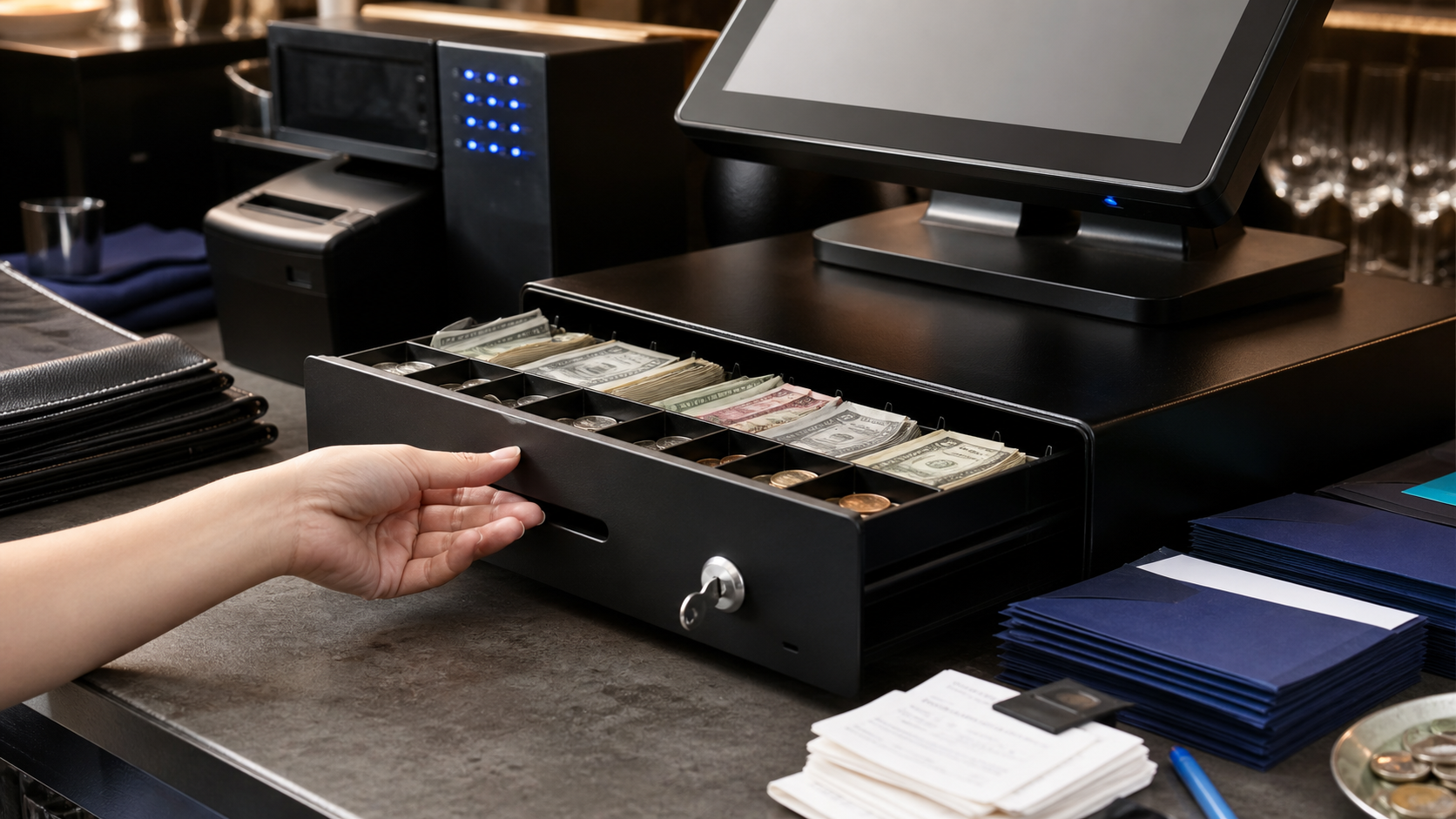
A restaurant drawer holds several kinds of money at once, and most closing problems come from mixing them. Separate them physically first, then count each stream with the Change Counter calculator so the report shows where every figure came from.
Cash tips belong to staff and follow different rules in most jurisdictions. Keeping them physically separate from the moment they are received prevents both a counting problem and a payroll one.
1. Choose Server Banks Or A Shared Drawer
Decide the model and stick to it. Individual server banks make every variance assignable and every count small. A shared drawer is simpler to set up and makes a shortage impossible to attribute. Neither is wrong, but running both informally on different nights guarantees confusion.
Making Server Banks Work
Each server signs for a counted bank at the start of the shift and reconciles it at the end, paying in the cash owed on their sales. It takes longer at close but removes almost every unassignable variance, which is why most higher volume restaurants use it.
- Pick one model and write it into the closing procedure.
- Have servers sign for banks at the start of the shift.
- Never let two people work from one bank.
- Reconcile each bank individually, not in a batch.
2. Separate Tips From Takings
Cash tips should never enter the takings drawer. Provide a separate container per server or a pooled tip box depending on your policy, and collect them at the point of payment. Untangling tips from sales at the end of the night is guesswork with payroll consequences.
Recording Tips Properly
Count and record cash tips separately, with their own document. Most jurisdictions require tip records for payroll or tax, and a figure derived by subtraction from a drawer count will not satisfy anyone reviewing it later.
- Use separate physical containers for tips.
- Collect tips at the point of payment, not at close.
- Count and record tips as their own figure.
- Follow local rules on tip distribution and reporting.
3. Log Delivery And Platform Cash
Cash on delivery orders and driver settlements move money that never touched a customer at your counter. Log each driver settlement with the order references and the amount, because these appear on the platform statement rather than the till report and will not reconcile otherwise.
Reconciling Platform Cash
Settle with drivers on a fixed schedule and record it. Cash collected on delivery is often owed back to the platform net of commission, so treating it as takings inflates the day and creates a shortage when the settlement is made.
- Record every driver settlement with order references.
- Keep platform cash separate from counter takings.
- Reconcile against the platform statement, not the till report.
- Settle on a fixed schedule rather than ad hoc.
4. Record Paid Outs To Suppliers
Restaurants pay for produce, deliveries and emergency supplies out of the drawer more often than most businesses. Every one needs a receipt in the drawer at the moment the cash leaves, with the supplier, the amount and who authorised it.
When To Use A Proper Fund
If paid outs happen daily, the drawer is functioning as petty cash and should be replaced by an imprest fund with vouchers. That keeps the till reconcilable and gives the kitchen a cleaner process. See petty cash reconciliation.
- Receipt in the drawer at the moment cash leaves.
- Record supplier, amount, reason and authoriser.
- Cap the value any one person may pay out.
- Move recurring purchases to a petty cash fund.

5. Close Each Section In Turn
Bar, restaurant and takeaway usually trade differently and often close at different times. Count each section as it closes rather than waiting for the last one, which keeps counts small, keeps them fresh, and avoids a single large count at the end of a long night.
Sequencing A Late Close
Order sections by closing time and count immediately after each one shuts. Nothing is gained by holding a counted bar drawer for two hours while the restaurant finishes, and a great deal is lost in attention. The lane logic in the cashier closing checklist applies here too.
- Count each section as it closes, not at the end.
- Label each count by section and shift.
- Keep section floats separate throughout.
- Do not merge section cash before counting.
6. Match Against The POS Report
Build the expected cash figure from the point of sale report with card, voucher and platform settlements removed, refunds deducted where cash actually left, and paid outs subtracted. Then compare against the counted figure.
The Usual Mismatch
Hospitality reports frequently blend service charge, card tips and cash tips into the takings line. Identify how yours treats each, because a service charge included in expected cash creates a nightly shortage that has nothing to do with counting. See balancing a cash register.
- Remove card, voucher and platform settlements.
- Check how the report treats service charge and card tips.
- Deduct cash refunds and paid outs only.
- Use the same report every night.
7. Drop To The Safe
Move counted cash to the safe in sealed labelled bags as each section finishes, rather than accumulating it in an office. Log the bag, the section, the value and the time. Late night hospitality carries a higher exposure than most retail, and holding time is the main variable you control.
Overnight Discipline
Restrict safe access to named people and record every opening. Where cash waits overnight for banking, the same evidence applies as for a deposit: sealed bag, serial recorded, value logged, two names. Deposit steps are in preparing a business bank deposit.
- Bag and drop each section as it is counted.
- Label with section, value, date and counter.
- Log every safe opening with a name and time.
- Minimise how long counted cash sits out.
8. Manager Review And Sign
A duty manager reviews each section count, the tip record, the paid out receipts and the variance before anything is filed. The signature is only meaningful if the review happened, so make the expectation explicit rather than assuming it.
What A Good Review Looks Like
Recount one denomination at random, check two paid out receipts against the log, confirm tips were recorded separately, and read the variance note. Five minutes per section, and it changes how carefully the counts are done.
- Review each section rather than the night as a whole.
- Spot check a denomination and a paid out receipt.
- Confirm tips were counted and recorded separately.
- Complete counted by and verified by before filing.
Worked Example
A restaurant with a bar closes at eleven and the dining room at ten thirty. Each section runs its own float, and delivery cash is settled with drivers separately at close.
| Stream | Handling | Where It Reconciles |
|---|---|---|
| Dining room takings | Counted at 22:45, own float | POS cash line for that section |
| Bar takings | Counted at 23:15, own float | POS cash line for the bar |
| Cash tips | Separate box, counted separately | Tip record for payroll |
| Delivery cash | Settled with drivers, logged | Platform statement |
| Supplier paid outs | Two receipts in the drawer | Deducted from expected cash |
| Safe drops | 2 sealed bags, logged | Safe log and banking record |
Each stream produces its own printed breakdown, so the manager reviews five short documents rather than trying to explain one combined figure that mixes takings, tips and platform money.
Final Checklist
- Confirm whether the site runs server banks or shared drawers.
- Keep cash tips physically separate from the moment received.
- Log every driver settlement with order references.
- Keep a receipt in the drawer for every paid out.
- Count each section as it closes.
- Build expected cash with tips and platform money excluded.
- Bag, label and drop to the safe promptly.
- Have the duty manager review and sign each section.
Hospitality closes late and tired, which is exactly why the separation has to happen during service rather than at the end. Nothing on this list is hard at eight in the evening and all of it is hard at midnight.
Frequently Asked Questions
Should servers keep their own banks?
For anything above modest volume, yes. Server banks make every variance assignable and keep individual counts small enough to be accurate. The cost is a longer close, which is usually recovered immediately in the time no longer spent investigating unassignable shortages on a shared drawer.
How should cash tips be handled at closing?
Count and record them entirely separately from takings, following your local rules on distribution and payroll reporting. Never derive a tip figure by subtracting expected sales from a drawer count, because that mixes a payroll number with a counting variance and neither will stand up.
Why does delivery cash never reconcile?
Because it usually is not your income. Cash collected on a platform order is often owed back net of commission and appears on the platform statement rather than the till report. Log driver settlements separately and reconcile them against the statement, not against the drawer.
Put It Into Practice
Start by separating tips at source if you are not already. It is the smallest change on this list and it removes the largest single source of confusion in hospitality cash.
Keep reading: Common Cash Counting Errors And How To Stop Them, How To Build A Daily Cash Count Sheet, Multi Currency Cash Counting Best Practices, How To Count A Cash Drawer Without Errors. The full cash counting guide library collects all fifteen walkthroughs, and the Change Counter calculator is always one click away.