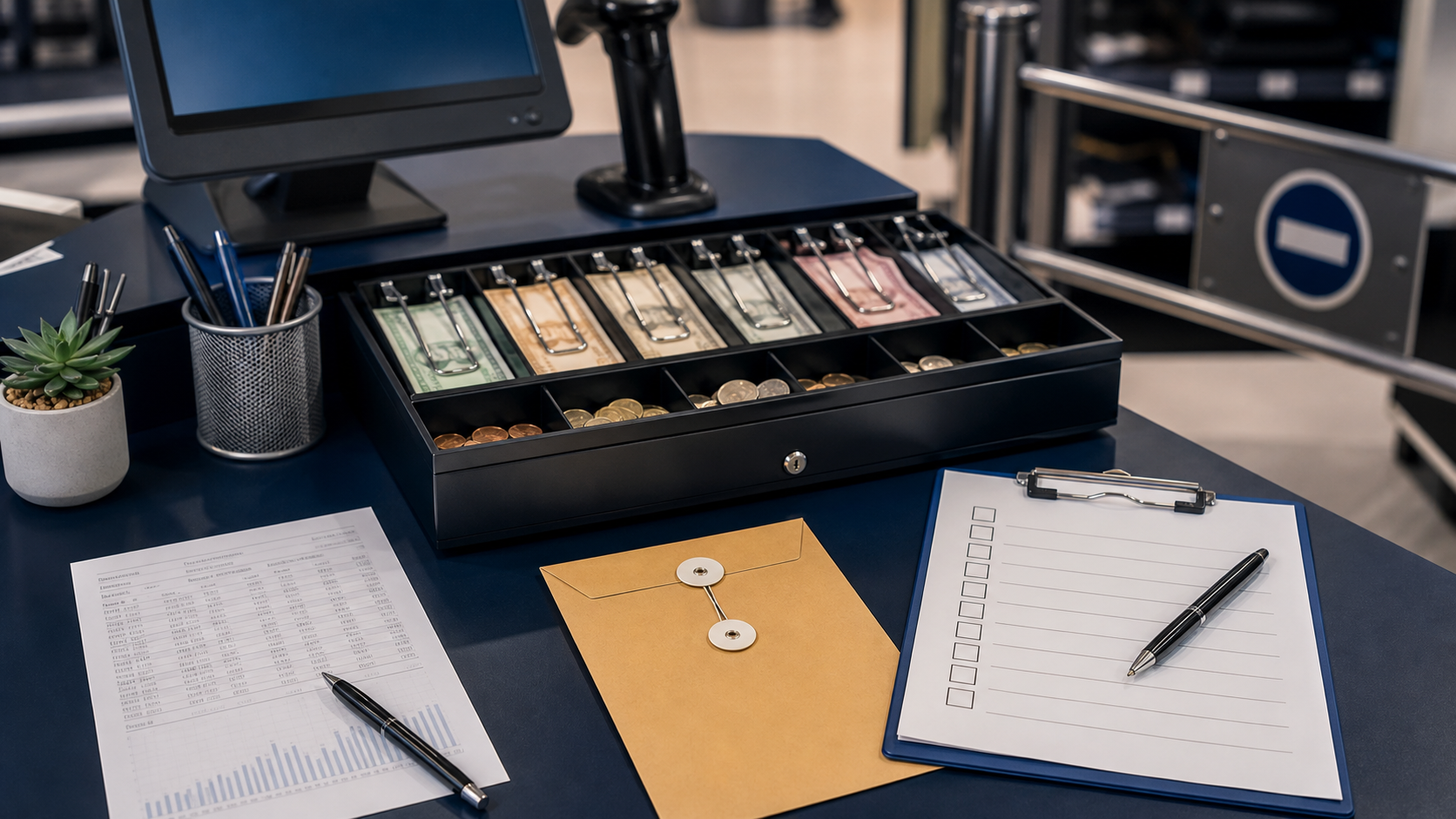
Closing routines drift because they are performed when everyone is tired. Writing the order down and counting with the Change Counter calculator keeps the last twenty minutes of a shift as disciplined as the first.
One transaction processed during a count invalidates everything already entered, and the person counting almost never notices. Close first, always.
1. Close The Lane To Customers
Turn off the lane light, place the closed sign, and serve the queue already waiting. Do not begin any part of the count while a customer could still approach. This sounds obvious and is the step most often compressed when a shift is running late.
Managing The Last Customers
Announce closing early enough that the queue clears naturally rather than being turned away at the till. A cashier caught between a waiting customer and a half finished count will prioritise the customer, which leaves an open drawer and an abandoned count.
- Switch the lane light off before touching the drawer.
- Finish or void every transaction in progress.
- Do not reopen the lane once counting has started.
- Direct late customers to an open lane rather than reopening.
2. Print The Shift Report
Take the reading immediately after the lane closes and before the drawer moves, so the report and the physical cash describe the same moment. Any gap between the two is a gap in which cash can legitimately change and your reconciliation cannot account for it.
Reading The Right Line
Use the cash only figure rather than the headline total, and know whether it already deducts refunds. Getting this wrong produces a shortage every night and quickly trains staff to ignore variances entirely. Detail sits in balancing a cash register at closing.
- Take the reading before the drawer leaves the lane.
- Use the cash only line, not the total takings.
- Confirm whether refunds are already deducted.
- Keep the printed report with the drawer through the count.
3. Move To A Secure Count Area
Carry the drawer in a closed container to a room away from the sales floor and out of public view. Counting at the lane exposes the whole day of takings to anyone at the counter and guarantees interruptions, both of which cost accuracy as well as security.
What The Area Needs
A flat surface, good light, a door and no through traffic. A camera covering the counting surface protects the counter as much as the business, since it turns a disputed figure into something reviewable rather than a matter of trust.
- Transport cash out of public view in a closed container.
- Count in a room that can be closed, not a corner.
- Ensure the surface is flat, clear and well lit.
- Avoid counting where colleagues walk through.
4. Remove And Replace The Float
Take the float out and rebuild the next float to the standard denomination mix, not just the standard value. A float of the correct amount in the wrong denominations forces the next shift to break notes constantly and encourages informal borrowing between lanes.
Preparing For Tomorrow
Rebuild floats while you still have the day mix in front of you rather than the next morning from the safe. It is faster, it uses the small denominations that have naturally accumulated, and it means the opening shift starts by counting a float rather than assembling one.
- Rebuild to a fixed denomination mix, not just a value.
- Count the rebuilt float before it goes to the safe.
- Bag and label the float with the lane and date.
- Record who prepared it.

5. Count In A Fixed Order
Notes from highest to lowest, then coin by size group. Each denomination counted, entered, and physically moved aside before the next one begins. The order is arbitrary in itself. Its value comes entirely from being the same every night for every person.
Why Order Beats Speed
A fixed sequence makes an interruption recoverable, because you know exactly where you were. It also makes counts comparable across staff, which is what allows a supervisor to see that one lane is consistently slower or consistently out. Method detail in counting a cash drawer.
- Use the same sequence every night regardless of who is counting.
- Enter each denomination once, then move the cash aside.
- Read the subtotal column back before accepting the total.
- Note anything set aside as unfit or foreign.
6. Review The Variance
Enter the expected cash figure only after the count is complete, then read the difference. Where it falls inside tolerance, record it and continue. Where it does not, recount before doing anything else, because the count is the most likely source.
Escalating Properly
A cashier should not be left to resolve a significant variance alone at the end of a shift. Define who is called, at what threshold, and what happens if that person is unavailable. Investigation order is set out in over or short causes and fixes.
- Count fully before viewing the expected figure.
- Recount before investigating anything else.
- Escalate above your written threshold rather than deciding alone.
- Record variances inside tolerance too.
7. Complete The Paperwork
Print the denomination report, complete the counted by and verified by lines, add the date and time, and attach it to the shift report and any refund or paid out slips. The bundle is the record. Loose sheets filed separately stop being evidence within a week.
Writing The Note
Add two lines explaining any variance and what was checked. Reviews happen days later, when nobody remembers the evening, and a number without a story invites suspicion that the note would have removed.
- Complete all sign off fields before printing.
- Attach refund and paid out slips to the report.
- Write a short note explaining any variance.
- File the bundle in date order by lane.
8. Hand Off The Deposit
Pass the counted cash and the paperwork to whoever is responsible for banking, and record the handoff with both names and a time. Cash that changes hands without a signature has no owner, and any later discrepancy becomes unassignable.
Overnight Holding
Where cash stays on site until morning, log it into the safe with the same discipline as a deposit. Note the bag, the value and the time. Preparation for the bank itself is covered in preparing a business bank deposit.
- Record both names and the time at handoff.
- Seal and label before the cash leaves your control.
- Log overnight holdings into the safe formally.
- Never leave counted cash unattended, even briefly.
Worked Example
A four lane store closes at eight. Lanes close in sequence rather than together, so one supervisor can cover every count without any drawer waiting unattended.
| Time | Action | Who |
|---|---|---|
| 19:45 | Lanes three and four close to customers | Cashiers |
| 19:50 | Reports taken, drawers moved to the office | Cashiers |
| 19:55 | Counts entered, floats rebuilt | Cashiers |
| 20:00 | Lanes one and two close, reports taken | Cashiers |
| 20:15 | Variances reviewed, reports signed | Supervisor |
| 20:25 | Cash and paperwork handed to the safe | Supervisor |
Staggering the closes means each count gets full attention and the supervisor verifies rather than queues. Every count in the sequence is entered into the Change Counter calculator and printed before the next lane arrives.
Final Checklist
- Close the lane to customers and finish the queue.
- Take the cash only report before moving the drawer.
- Carry the drawer out of public view to a secure area.
- Rebuild the next float to the standard mix.
- Count in the same fixed order every night.
- Enter the expected figure only after counting.
- Complete and sign the report, attaching all slips.
- Record the handoff with both names and a time.
Print this list and put it in the counting room. Closing procedures survive on being visible at the moment they are needed, not on having been read during induction six months ago.
Frequently Asked Questions
Should all lanes close at the same time?
Staggering is better where one supervisor covers several lanes, because it prevents drawers waiting unattended and lets the supervisor verify each count properly. Closing everything at once creates a queue of counted drawers and a rushed review, which is where sign off becomes a formality.
Can a cashier count their own drawer?
Yes, and it should always be verified by someone else. The cashier counts because they know what happened during the shift, and a second person reviews because a count checked only by the person who made it provides no independent assurance to anybody.
What if the cashier shift ends before the count finishes?
Finish the count. Sending someone home mid count leaves a drawer that belongs to nobody and a figure that cannot be assigned. If this happens often, the closing routine is starting too late and the schedule needs adjusting rather than the count being shortened.
Put It Into Practice
Time your current closing routine from lane light off to safe. Most stores find the count itself is short and the interruptions are long, which points at the environment rather than the method.
Keep reading: Cash Handling Procedures Every Business Needs, Cash Drawer Over Or Short: Causes And Fixes, Petty Cash Reconciliation Step By Step, Counting Money By Denomination The Reliable Way. The full cash counting guide library collects all fifteen walkthroughs, and the Change Counter calculator is always one click away.