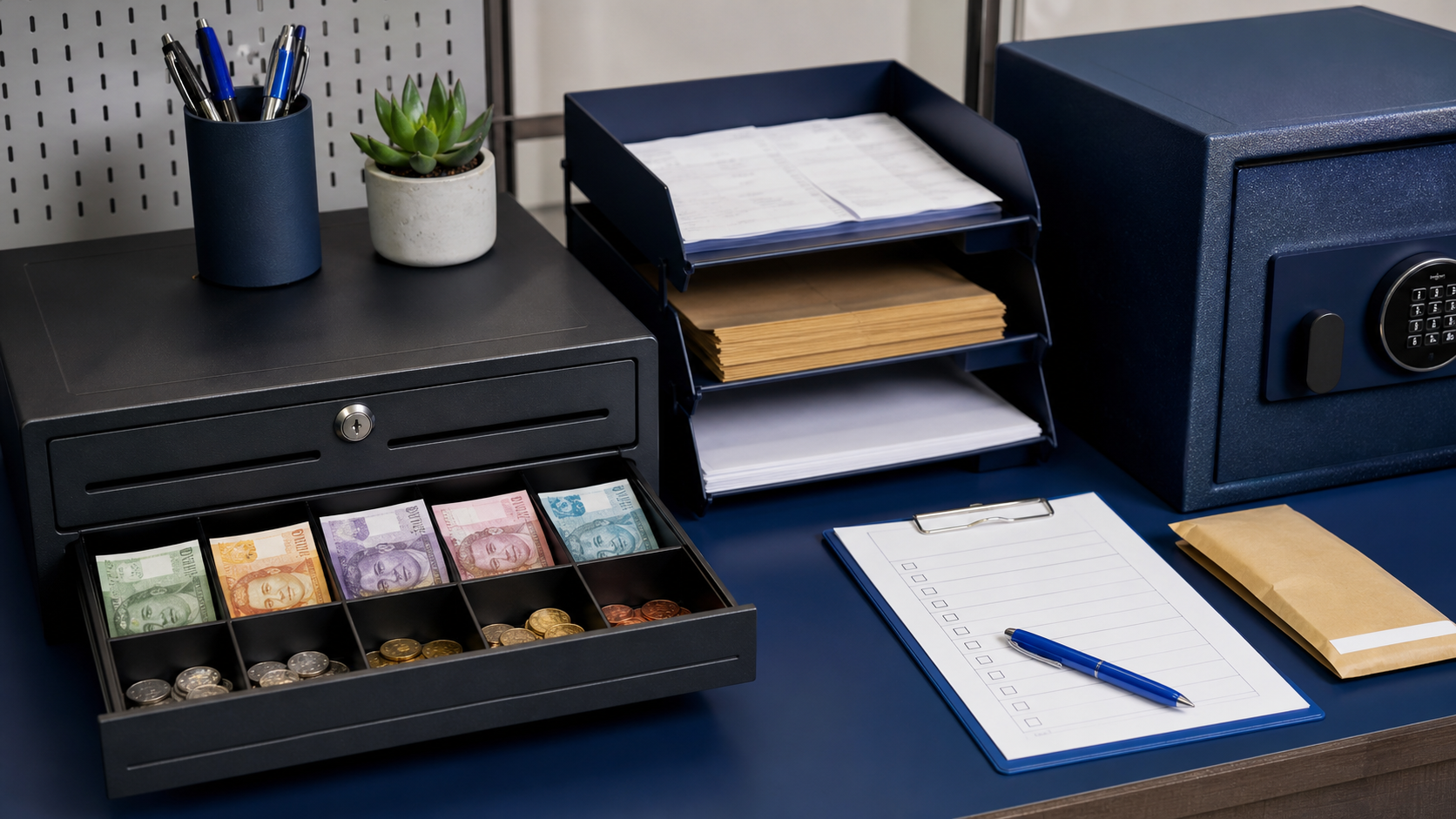
Cash controls fail when they are written for an organisation larger than the one running them. The eight areas below scale down honestly, and each of them pairs with a counted record from the Change Counter calculator rather than a verbal assurance.
Good cash procedure is not an accusation. It is what allows an honest employee to prove they were honest, which is why the staff who handle the most cash usually welcome it.
1. Name The Roles
Write down who may open a drawer, who may authorise a refund, who counts, who verifies and who banks. Ambiguity is the enemy here. When everyone can do everything, nobody is accountable for anything, and a variance becomes a conversation about who might have been at the till.
Separating Duties Realistically
Full separation needs more people than most small businesses have. The practical minimum is that the person who counts is not the only person who reviews. Even a next morning review by an owner adds meaningful friction, because it means every count will be looked at by somebody.
- List the roles by name, not just by job title.
- Keep counting and reviewing in different hands wherever possible.
- Restrict refund and paid out authority to named people.
- Review the list whenever staff change, not annually.
2. Set A Drawer Limit
Decide the maximum cash a drawer may hold before some of it is removed. The limit protects against loss in a robbery, reduces what is exposed if a drawer is left open, and keeps counts manageable. Post the figure where the lane can see it rather than burying it in a manual.
Choosing The Number
Base it on how quickly the lane accumulates cash and how often someone can realistically perform a drop. A limit that is exceeded every hour will be ignored within a week. A limit that is never reached is not doing anything. Watch a few real shifts before setting it.
- Set the limit from observed takings, not from a guess.
- Display it at the lane so it is visible during a shift.
- Include high value notes specifically, they accumulate fastest.
- Adjust it for known peaks rather than leaving it fixed all year.
3. Schedule Safe Drops
A drop removes cash from the drawer to the safe during a shift. Log each one at the moment it happens with the amount, the time and who performed it, because a drop that is remembered rather than recorded turns into a shortage at closing time.
Keeping Drops Traceable
Use sealed envelopes or drop bags with sequential numbers and record the number. That way the closing count, the drop log and the safe contents can be reconciled independently. Unnumbered drops in a shared safe are almost impossible to audit after the fact.
- Record amount, time, person and envelope number for every drop.
- Seal drops immediately, do not accumulate loose cash in the safe.
- Reconcile the drop log against the safe at closing.
- Never allow a drop to be reversed to make a drawer balance.
4. Control Receipts And Voids
Every void, no sale and cash refund needs a paper trail and a second signature above a threshold you set. These transactions are the ordinary mechanism by which cash leaves a drawer without a customer, which makes them the first place a review should look.
Reading The Void Report
Look at void frequency by person rather than by total value. A pattern of small voids concentrated on one shift says more than a single large one, and it is invisible unless someone reviews the report regularly. Related symptoms appear in over or short causes and fixes.
- Require a slip and an authorising initial for cash refunds.
- Set a value above which a second signature is mandatory.
- Review void and no sale reports by person, not just by total.
- Keep receipts inside the drawer until the count is finished.

5. Define The Shift Change
A drawer that passes between two people without a count belongs to neither of them. Either each person gets a fresh drawer with a counted float, or the drawer is counted at handover and both parties sign. Anything else makes a later variance unassignable.
The Cost Of Skipping It
Shared drawers are the most common single reason a business cannot resolve variances. The count itself takes a few minutes, whereas an unassignable shortage costs a supervisor an hour and costs trust indefinitely. The lane procedure is in the cashier closing checklist.
- Issue a fresh counted drawer at each handover where possible.
- Count and sign at handover if drawers must be shared.
- Record both names and the time on the handover count.
- Never leave a drawer unattended between shifts.
6. Write A Variance Rule
Decide in advance what happens at each level of difference. Below a threshold, record and move on. Above it, recount independently. Above a higher one, escalate to a manager and investigate formally. Writing this down before you need it removes the pressure to make a judgement while tired.
Trends Over Incidents
A single variance means little. The same small shortage on the same shift for three weeks means a great deal. Record every variance including the ones inside tolerance, because those are precisely the ones that reveal a pattern. Investigation steps are in cash drawer over or short.
- Set thresholds in writing before an incident occurs.
- Record variances inside tolerance as well as outside it.
- Review the trend monthly rather than reacting nightly.
- Never adjust a count to make it fall inside tolerance.
7. Fix The Deposit Routine
Bank on a predictable schedule with a documented preparation process and dual control on the count. Irregular banking increases what is held on site, complicates reconciliation, and makes it harder to notice when a deposit is short. Predictability is the control here.
Documenting The Handoff
Record who prepared the deposit, who verified it, the bag serial and the time it left. If a collection service is used, get a signed receipt at the point of handover. Preparation detail is in preparing a business bank deposit.
- Bank on a fixed schedule rather than when convenient.
- Require two people for preparation and sealing.
- Record the bag serial and the handover time.
- Keep your denomination record with the slip copy.
8. Audit Without Warning
An occasional unannounced drawer count does more for accuracy than any amount of written policy. It need not be adversarial or frequent. Knowing that a count could happen on any shift is what changes behaviour, and it also surfaces genuine process faults nobody had reported.
Running It Well
Count with the person whose drawer it is present, explain that it is routine, and share the result either way. An audit that only appears when someone is suspected becomes a punishment. One that happens randomly and produces a clean result most of the time becomes normal.
- Schedule spot counts randomly rather than on a known cycle.
- Include the drawer holder rather than counting behind them.
- Share the result whether it is clean or not.
- Record spot counts alongside closing counts for trend analysis.
Worked Example
A cafe with four staff and two lanes writes a one page policy. It is short enough to be read during induction and specific enough to be followed without asking.
| Control | The Rule | Evidence Produced |
|---|---|---|
| Roles | Owner and two supervisors may authorise refunds | Named list on the office wall |
| Drawer limit | Maximum 300 in the drawer at any time | Drop log entries |
| Safe drops | Numbered envelope, logged at the time | Sequential envelope numbers |
| Shift change | Fresh counted drawer per person | Handover count sheet |
| Variance rule | Under 2 recorded, over 2 recounted, over 10 escalated | Variance log |
| Spot audit | One unannounced count per fortnight | Spot count report |
Each control produces a document rather than a verbal assurance, and every count behind those documents is a printed denomination report from the Change Counter calculator.
Final Checklist
- Name who may count, verify, refund and bank.
- Set and display a drawer limit based on real takings.
- Log every safe drop with amount, time, person and envelope.
- Require slips and authorisation for refunds and paid outs.
- Count at every shift change or issue fresh drawers.
- Write variance thresholds before you need them.
- Bank on a fixed schedule under dual control.
- Run unannounced spot counts and share the results.
Adopt these one at a time rather than all at once. A single control that is genuinely followed beats a full policy that gets quietly abandoned in the second busy week.
Frequently Asked Questions
How much policy does a two person business really need?
Less than a chain, but not none. At minimum: a counted float, a drawer limit, a rule that refunds need a slip, and a second pair of eyes on the closing figure even if that happens the next morning. One page is enough, and one page that is followed beats a manual that is not.
Do these controls imply we do not trust our staff?
The opposite. Without a documented count and a second signature, an honest employee has no way to demonstrate that a shortage was not theirs. Controls create evidence, and evidence protects the person handling the money at least as much as it protects the business.
How long should cash records be kept?
Follow your accounting and tax retention rules, which vary by jurisdiction and are usually measured in years rather than months. Keep the counted report with the sales summary and deposit evidence so a single query can be answered from one file. See building a daily cash count sheet.
Put It Into Practice
Pick the two controls your business is weakest on and put them in place this month. The rest of the guide library covers each of them in operational detail when you are ready to go further.
Keep reading: How To Count Coins Quickly And Stay Accurate, How To Balance A Cash Register At Closing, Counting Money By Denomination The Reliable Way, Cashier Closing Procedure Checklist For Retail. The full cash counting guide library collects all fifteen walkthroughs, and the Change Counter calculator is always one click away.