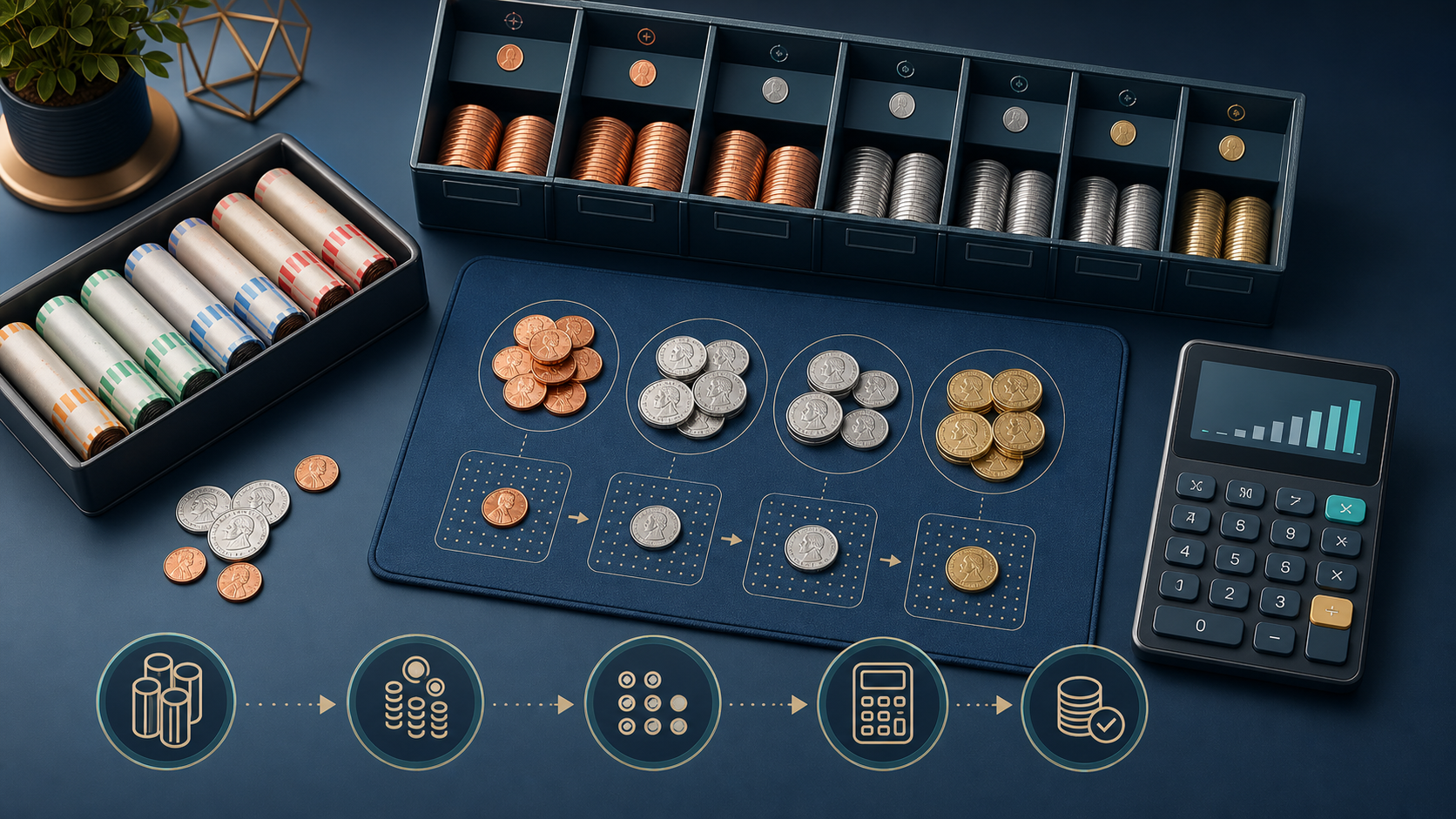
Coins punish mental arithmetic more than notes do, because the quantities are larger and the values are smaller. Sort them properly, batch them consistently, and let the Change Counter calculator handle the multiplication that slows everyone else down.
Counting coins into fixed batches of ten or twenty means a lost count costs you one batch instead of the whole pile. It is the single change that speeds up most coin counting.
1. Clear A Sorting Surface
Coins need more space than people allow them. A flat surface with a raised edge, good light from the side rather than overhead, and nothing else on it. Carpet, sloped counters and cluttered desks all cost more time in dropped and lost coins than the space would have taken.
Setting Up To Work
Put a shallow tray at your left for uncounted coin and a second at your right for finished batches. The physical separation does the same job as moving a stack aside when you count notes, and it means an interruption never leaves you wondering which pile you were on.
- Use a tray with a lip so a knocked pile stays on the table.
- Light the surface from the side to make edge milling visible.
- Keep a small dish for foreign and damaged pieces.
- Work standing if the count is large, since it keeps the pace up.
2. Sort By Diameter First
Sort by physical size before you think about value. Diameter is faster for the eye and the hand to judge than a printed number, especially on worn coins, and it naturally separates the pairs that people confuse most often. Value based sorting requires reading every piece, which is far slower.
The Pairs That Cause Trouble
Most currencies have at least one pair of similar sized coins with very different values, and mixed lighting makes them harder to tell apart. Once sorted by size, confirm the value of each group before you start batching so a whole group cannot be entered on the wrong row.
- Sweep coins into size groups with the side of your hand, not one at a time.
- Check one coin from each group against its printed value before batching.
- Keep bimetallic coins in their own group, they sort by eye instantly.
- Set aside anything that will not sit flat, it is usually damaged or foreign.
3. Work In Fixed Batches
Count each size group into batches of ten or twenty, then count the batches. Recounting twelve batches of twenty is far quicker than recounting two hundred and forty loose coins, and if you are interrupted the damage is limited to the batch in your hand rather than the whole group.
Choosing A Batch Size
Pick one batch size and keep it for the whole session. Ten suits small hands and low value coins. Twenty suits larger coins and experienced counters. Mixing sizes within a session is what causes a batch of ten to be counted as twenty, which is a mistake that hides well.
- Stack batches rather than leaving them loose, stacks are countable at a glance.
- Keep every batch in a group the same height so an odd one stands out.
- Count leftover coins as a final partial batch, never merge them backwards.
- Enter the group total in one go rather than batch by batch.
4. Use Rolls As Units
Where your bank supplies coin wrappers, a full roll is a fixed quantity that needs no recounting. Roll everything that makes a complete roll, count the rolls, and treat the loose remainder as the only part still needing attention. Banks generally prefer rolled coin anyway, so the work is not wasted.
Rolling Without Losing Track
Never part fill a roll and set it aside as though it were complete. Either finish it or empty it back into the loose pile. A partially filled wrapper looks identical to a full one an hour later, and it will be counted as a full roll by whoever handles it next. Deposit preparation is covered in preparing a business bank deposit.
- Confirm the standard quantity per roll for each denomination.
- Mark part filled wrappers clearly or empty them out.
- Weigh finished rolls if you have a scale, it catches a short roll instantly.
- Enter rolls as quantity times coins per roll, not as a rounded estimate.

5. Set Damaged Coins Aside
Bent, corroded, drilled and foreign coins do not belong in the count. They will not pass at a bank, they will not go through a sorting machine, and they distort the piece count that you would otherwise use as a sanity check. Put them in the separate dish the moment you see them.
Deciding What To Do With Them
Foreign coins of a currency you handle regularly are worth keeping for a separate count. Everything else is usually easier to write off than to process, but that should be a documented decision rather than something that happens quietly in someone pocket. Multi currency handling is covered in multi currency cash counting.
- Pull damaged pieces out during sorting, not during entry.
- Keep foreign coins by currency rather than in one mixed dish.
- Note the number set aside so the piece count still reconciles.
- Follow your own policy for what happens to unusable coin.
6. Mark Your Recount Points
Long coin counts get interrupted. A phone rings, a customer appears, a delivery arrives. Before you step away, put the batch you were holding into the uncounted tray rather than the finished one. When in doubt, the safe assumption is always that a batch has not yet been counted.
Recovering From An Interruption
If you genuinely cannot remember where you were, recount that size group from the start. It costs a minute. Guessing costs a variance that will be chased for far longer than a minute, and it teaches everyone that the count is approximate.
- Never leave a partial batch in the finished tray.
- Enter the group total before answering anything that can wait.
- Recount the current group if you lose track, rather than estimating.
- Finish a size group before starting the next one.
7. Check Subtotals By Sight
Coin subtotals have a shape you learn quickly. Two hundred and forty of the smallest denomination will not add up to a large figure, and a group of high value coins that produces a tiny subtotal points at the wrong row. Read the column back before you accept the total.
The Row Mix Up
The most common coin error is entering a group on the neighbouring row, because the values sit next to each other in the list. The subtotal makes it obvious, since it will be roughly double or half what you expected. Similar traps are collected in common cash counting errors.
- Compare each subtotal against a rough expectation before moving on.
- Check the piece count against how full the tray looked.
- Confirm the highest value coin row before anything else.
- Look for two adjacent rows that appear to have been swapped.
8. Store And Label The Result
Finish by putting the counted coin somewhere it will not be topped up. A counted bag that stays open on a desk stops being a counted bag the moment somebody adds a handful. Seal it, label it with the value and the date, and record the count while the detail is fresh.
Making The Record Useful
Label the saved count by source rather than by day alone, since coin often arrives from several places. Print the breakdown when it accompanies a deposit, and pair it with a daily cash count sheet when it feeds into a wider set of records.
- Seal and label bags immediately after counting.
- Write the value, date and source on the label, not just the value.
- Save or export the breakdown before you clear the screen.
- Store counted coin apart from uncounted coin.
Worked Example
A market stall returns with a tub of mixed coin. Sorting by diameter produces five groups. Each group is batched into twenties, the full rolls are set aside as units, and the loose remainder is counted last.
| Group | How It Was Counted | Entered As |
|---|---|---|
| Highest value coin | 6 batches of 20 plus 7 loose | 127 pieces |
| Second value coin | 4 full rolls plus 12 loose | Rolls times roll quantity, plus 12 |
| Middle value coin | 9 batches of 20 | 180 pieces |
| Small value coin | 3 batches of 20 plus 4 loose | 64 pieces |
| Smallest coin | Weighed, then spot checked | Estimate confirmed by batch |
| Damaged and foreign | Removed to a separate dish | Excluded, noted on the sheet |
Each group is entered on its own row in the Change Counter calculator, which multiplies quantity by face value and shows the coin subtotal beside the note subtotal. Nothing is added up by hand at any point.
Final Checklist
- Clear a flat, well lit surface with trays either side.
- Sort by diameter, then confirm the value of each group.
- Batch into a single fixed size for the whole session.
- Roll complete rolls and treat them as fixed quantities.
- Remove damaged and foreign coin to a separate dish.
- Enter one group at a time and move it aside.
- Read the subtotal column back before accepting the total.
- Seal, label and record the counted coin immediately.
None of these steps are difficult, and none of them are optional if you want the same answer twice. Coin counting rewards a boring routine far more than it rewards speed.
Frequently Asked Questions
Is weighing coins accurate enough to skip counting?
Weighing is a reasonable cross check and a poor primary method. Worn coins lose mass, some denominations sit close together in weight, and a single foreign coin can move a reading. Use a scale to confirm a batch or a roll you have already counted, not to replace the count itself.
Should coins be counted before or after banknotes?
Count notes first while your attention is sharpest, because a single note error moves the total far more than a single coin error does. Coins take longer but forgive small mistakes, so they suit the later part of a session. Whichever order you pick, keep it consistent so counts stay comparable.
What do I do with a coin I cannot identify?
Put it in the separate dish and keep counting. Stopping mid group to research one coin is how a batch gets counted twice. Deal with the dish at the end, and if the piece belongs to a currency you handle regularly, count it into that currency separately rather than guessing a value.
Put It Into Practice
Try the batch method on the next coin count you face. Most people find the sorting takes a few minutes longer and the counting takes considerably less, with the recounts disappearing entirely.
Keep reading: Cash Drawer Over Or Short: Causes And Fixes, Petty Cash Reconciliation Step By Step, Cashier Closing Procedure Checklist For Retail, Event Cash Reconciliation For Tickets And Donations. The full cash counting guide library collects all fifteen walkthroughs, and the Change Counter calculator is always one click away.